Leelanau Commissioner Update May 2026
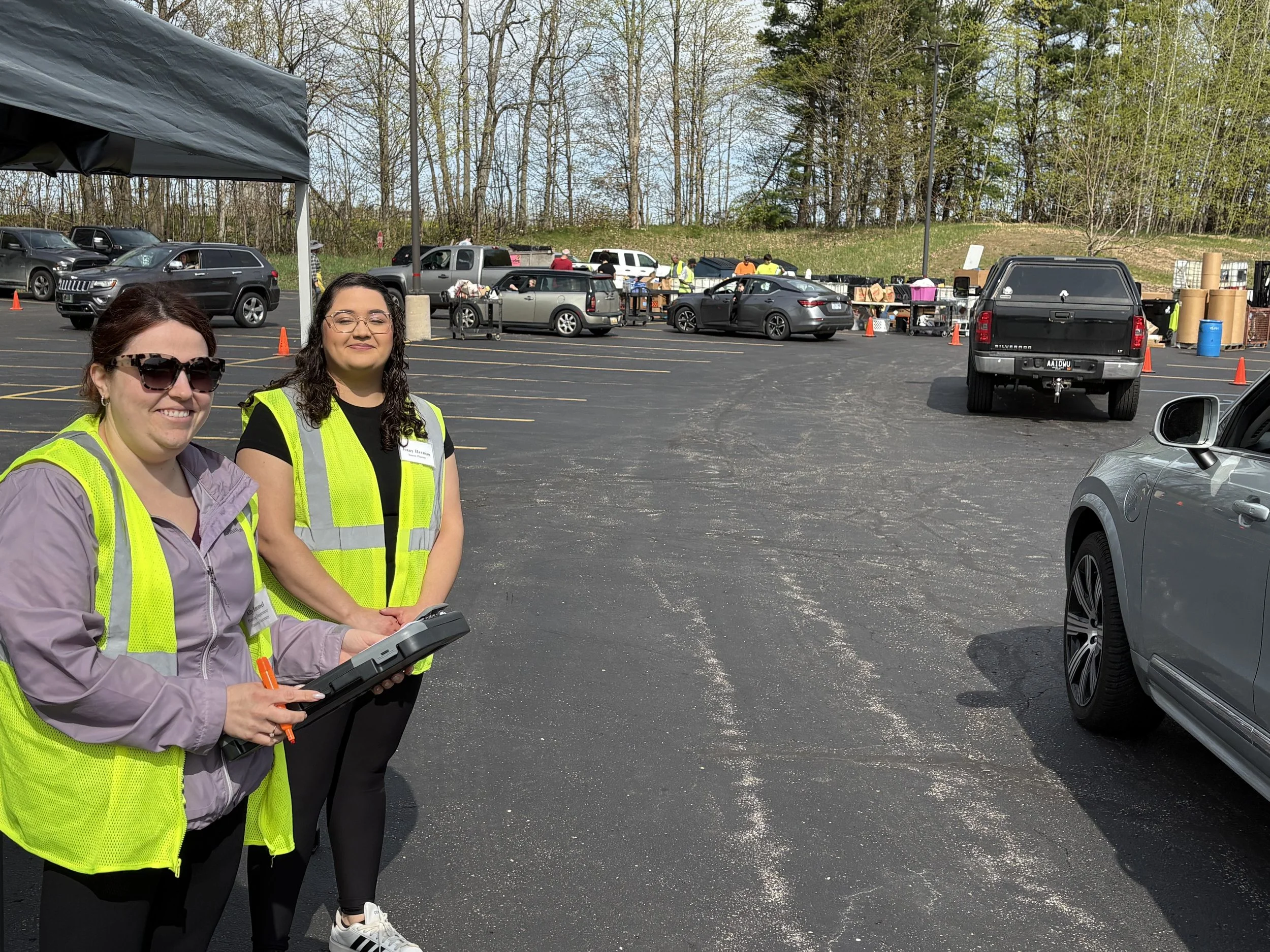
Leelanau County operates one of the most efficient recycling programs in the state, and county participation is among the highest in Michigan. It’s run by the county Planning and Community Development Department, which is headed by Director Gail Myer.
Above, Planning Department Secretary Allison Immel, left, and Senior Planner Jenny Herman greet residents making drop-offs in mid-May at a household hazardous waste collection at the county government center. Future collections are scheduled at Glen Lake Community Schools for electronic waste on June 13, scrap tires and mattresses on June 19, and household hazardous waste on June 20. Visit the county website or call the Planning Department at 256-9812 for more information or to sign up.
Leelanau Commissioner Update May 2026
Provided by Alan Campbell Leelanau County Commissioner District No. 5 (Leland and Centerville Townships)
Dear Readers:
It was a busy—and fairly controversial—May for Leelanau government. It’s been busy for residents as well with county yards, flower pots, and crops taking on life.
Thank you for opening the Leelanau Commissioner newsletter or visiting the leelanaucommissioner.com website. Please keep in mind that content on the website has been produced solely by me and may not reflect the opinions of other county commissioners.
If you know someone interested in receiving the newsletter, please forward this email to them so they may subscribe. I will not share email addresses—my days of making a living through publishing have long passed—and it's simple to unsubscribe.
Past newsletters and important documents can be found at leelanaucommissioner.com.
This edition addresses the following issues:
• A proposed policy authorizing the county administrator to pay up to $25,000 without board approval or participation to settle claims against the county, including lawsuits;
• How public involvement changed the course of a proposed policy that would have authorized inspectors to issue civil tickets for soil erosion and building code violations;
• The unusual path (and my involvement) taken in setting the 2026 county millage rate while ensuring that a portion of revenues is set aside to rebuild our contingency fund;
• And some personal notes that, hopefully, fall below the level of misusing this newsletter’s spotlight.
My goal with this newsletter is simple: to make the work of the County Board of Commissioners transparent. Feedback is welcome through a link in this newsletter or by calling me at 231-492-4972. I enjoy our conversations.
Thank you.
Alan Campbell
Past emails and reports can be found on my website, leelanaucommissioner.com.
Author’s Note: Content is provided by Alan Campbell
Proposed Policy Would Shift $25,000 in Settlement Approval to Administrator
June 1st, 2026
We were set up to commit two mistakes, one involving public notice protocol and the other breaching the spirit of the Open Meetings Act, at one meeting. Thankfully, neither intrusion into the expectations of citizens for access to the business conducted by their public officials was committed, although questions continue to flow about how the Leelanau County Board of Commissioners got into such a predicament.
And I’m hearing—and listening to—backlash about a proposed policy change that was at the heart of an unusual agenda item at our May 19 meeting. The policy would authorize the county administrator to spend up to $25,000 without board approval or involvement to settle ... just about anything.
Included are claims, litigation, and separation agreements. Those would mostly involve employees, union and non-union, and even elected officials.
Presently, such settlements can only be authorized by the County Board.
The policy would go further. Claims of up to $25,000 made by citizens could also be paid without the consent of the County Board, whether or not a lawsuit was filed.
The policy would also take away the ability of county commissioners—your elected representatives—to settle large claims without first getting approval from the administrator or legal counsel for the county.
I can think of situations in which shifting authority to settle legitimate lawsuits filed against the county from a body of seven to one or two individuals would be detrimental.
For instance, what if paying a large sum to settle a lawsuit claiming mismanagement reflected poorly on the administrator?
And I’ve said for years that the only guaranteed winners of lawsuits are attorneys arguing their clients’ cases. Might that incentive be a reason to leave a case open?
To be clear, I do not allege that our present administrator or legal counsel would not act with integrity. But I am saying that the proposed policy strips elected officials of their authority and places it with positions, not individuals. If approved, the policy could remain in effect longer than any elected or appointed official involved in the process holds their present office.
I’ve been told by proponents that such a policy is quite common in county government, so I made calls to commissioners from three neighboring and somewhat comparable counties. Neither Benzie, nor Manistee, nor Charlevoix counties have such a policy in place, according to the chairs or vice chair of their county boards. None of the county leaders understood why Leelanau would even consider yielding that much authority to a non-elected office.
Reacting to the anticipated claim that failing to pass the policy would constitute “micromanaging,” a commissioner from another county whom I highly respect responded with:
“It’s nothing to do with micromanaging. It’s all about accountability. I have to go out and meet with the people who elected me, and I have to be accountable for what’s happening in the county when I do that.”
Public Left in the Dark
Now back to how we came too close to violating public trust—your trust.
The agenda for our May 19 regular session included a surprise item that we had not discussed the previous week at the Executive Committee meeting. It was stated as:
5. Closed Session to Consider Discussion of Attorney-Client Privileged Material Exempt from Disclosure Under MCL 15.268(1)(h) and 15.243(1)(g), Concerning Item 5a.
a. Consider Adoption of Resolution Concerning Administrative Settlement Authority and Ratification of Past Administrative Settlements. (Late Addition).
I dislike late agenda additions in general, especially those that do not arise from emergency situations. Please note that, as written, the agenda item includes two topics: a resolution diminishing County Board authority and approval of employment settlements already signed by the administrator.
In this case, one or perhaps both issues could (and should) have been handled within the parameters of an open meeting. The closed session, however, was legal because it was centered on written material from our attorney, who discussed legal ramifications over the telephone.
One topic was our attorney’s opinion about a settlement policy, discussed above, that would hand over authority to the administrator. A proposed resolution and the policy were before us in the closed session. We had been emailed copies after working hours the previous day by the county administrator. That was the first I had been informed of either.
Before approving the closed-session motion, I asked that “adoption of a resolution concerning administrative settlement authority” be removed and discussed in open session. It would have violated the Open Meetings Act to discuss anything beyond the legal opinion of a public policy in closed session. Commissioners agreed.
When we emerged from behind closed doors, I moved to table the policy because the public had not been allowed to comment—and, in fact, had not even been given an opportunity to review it. Approving such a policy at that meeting would be unethical, I believe.
The bottom line is that we did move out of closed session to approve, in post-mortem fashion, three settlements for terminated employees that had not been given board approval. The latest was the largest, in the amount of $4,770, representing four weeks of employment. Signed on April 18, the document ended a union grievance that I understand had to do with an alleged county failure to follow union contract procedures when letting someone go. I have requested copies of the grievance and settlement.
I give County Treasurer John Gallagher kudos for withholding payment until he was certain the settlement was properly authorized. It should have been an agenda item at our Executive Committee meeting and handled as normal business the following week.
Had the proposed policy been in place, it’s possible that neither the public nor commissioners would know about the settlements or payouts.
That’s one reason I oppose it.
Public Pushes for Changes in Civil Ticketing Ordinance
June 1st, 2026
So what’s a Civil Infractions Bureau, and why does Leelanau County need one?
That question caused a bit of a rumble among residents who spoke at County Board meetings in May. Public comment, in turn, caused a proposal brought by Administrator James Dyer to be postponed for at least one month.
As these things tend to go, the proposal was well-founded in principle but needed more input from commissioners and affected constituents.
The concern most often expressed was the possible creation of a platoon of inspectors all authorized to hand out tickets for the most minute code infractions. In other words, bureaucratic overreach.
That was not the intent, Mr. Dyer assured us. I was glad to hear that he and Michael Awry, a respected builder with 43 years of experience who resides in Elmwood Township, had a sit-down meeting at which concerns of the county construction industry were considered. To his credit, Mr. Dyer took those concerns to heart. I look forward to reviewing an improved resolution at our June meetings.
And thank you to Mr. Awry for taking a leadership role in getting the proposal back on the rails. His approach was calm, objective, and effective.
It helped that he brought persuasive points to the table.
I naively voted to recommend the new policy at our Executive Committee meeting because I supported the concept, which has been adopted successfully by townships in Leelanau for enforcing zoning ordinances. I like the idea of handling such violations more like a parking ticket than a criminal act, and I’m told using a civil rather than criminal approach is more efficient and cost-effective.
I also prefer handling nonviolent issues in civil court to avoid tarnishing the records of residents with criminal convictions.
I didn’t fully understand the reasoning for establishing a Municipal Civil Infraction Bureau until learning that state law requires counties to have one in order to issue civil violation tickets.
OK, so there are advantages. But after reading deeper into the proposal before us—thank you, residents, for becoming part of the process—several flaws emerged. At our monthly Board of Commissioners meeting held on May 19, I identified problems I believe need fixing before the issue comes back to the board. They include:
• Requiring a better and more extensive notice procedure prior to the issuance of a citation.
• The ordinance authorized the County Board to establish the levels of civil fines, costs, and fees. I am uncomfortable creating a ticketing system without an accompanying document establishing those amounts to ensure they are not onerous to property owners.
• As written, all inspectors could be empowered to issue citations. That power should be limited to department directors such as County Building Official Heather Weber, who heads the Leelanau County Department of Building Safety (code office).
• The Bureau “shall operate under the supervision of the county administrator or his or her designee,” the proposed ordinance stated. The system should not be placed solely under the authority of county administration. The elected County Board should appoint bureau members and possibly be designated as an appellate option before an alleged violation is taken to court and enters what could become an expensive process.
• Section 7 allows for a “formal hearing as provided by law.” What body would oversee such a hearing? The ordinance does not make that designation. It should.
• This could be just me, but the ordinance would most affect our county Building Safety Department and the Leelanau Conservation District, which handles permitting for soil erosion. I would have liked to invite the heads of those two departments to explain the policy's effects as they see them. I did not mention this concern at the meeting.
It was my mistake to vote to recommend the ordinance, but that’s not how my final vote would have gone. (I hear you. So I voted for the bill before voting against it. That’s a poor excuse on both county and congressional levels.)
On the positive side, the system worked because citizen input changed the outcome. Thankfully, the proposed policy was a regular agenda item and published on the county website prior to the meeting.
I routinely vote “no” on 11th-hour additions to our agendas that will have a lasting effect on how the county goes about its business. I dislike being handed paperwork for policy changes or spending proposals at meetings because that often means the public has not had access to the material through our published meeting notices.
The proper procedure is to provide the public with the same information given to commissioners. That encourages citizen involvement and its positive outcomes.
Which is what is occurring with the county’s switch to civil infractions.
Twists, turns toward new millage rate
June 1st, 2026
I would not call it pretty, but the Leelanau County Board of Commissioners eventually did reach a compromise and approved a property tax rate that you’ll see on tax bills mailed in late July.
There are a couple ways to look at our new property tax rate of 3.2002 mills.
One is that it represents the maximum allowed by our state Constitution without a vote to raise the levy, which I believe would be shunned.
The other is that it represents a 1.6% reduction from last year’s 2025 rate of 3.2520. The reduction is allowed because the taxable value of all property in Leelanau County has increased by about 6 percent—what I consider a torrid pace.
I would consider the process to set the new rate as atypical but healthy. Most of the discussion and action occurred at the Executive Committee meeting.
Commissioner Will Bunek, a conservative, started with a motion to levy 3.1900 mills, which would reduce county receipts by approximately $200,000. He felt taxpayers deserve a break, which is hard to deny given gas prices and other inflation factors.
Commissioner Ty Wessell then moved to amend the motion to levy the highest rate possible of 3.2002 mills due to budget constraints. The higher rate will increase revenues by $540,000, which is a lot of money but not overwhelming for a $19 million county budget. Voting for the amendment were all commissioners but Mr. Bunek. My comment, according to meeting minutes, was that we should dedicate a portion of the increased revenue to some type of “rainy day fund” given our tight budget situation.
Then Mr. Bunek got ahead of me in moving that we dedicate $200,000 of the increased revenue to our contingency fund. Within our present budget, the contingency fund is set at just $200,000, which I feel is far too low and likely won’t last until Dec. 31. The motion, which I seconded, would double the contingency fund in the 2027 budget to $400,000.
The final vote passed 4–3 with support from Mr. Wessell, Chair Steve Yoder, Ms. Allgaier, and myself. The higher amount on paper would produce $14,242,794. That amount does not account for unpaid taxes. Our 2026 budget for property tax revenue, as recommended by Mr. Dyer, predicts $14,152,680 in tax revenue.
Please keep in mind that one mill is equal to $1 of tax owed per $1,000 of the taxable value of your property. Keep in mind that your taxable value cannot represent more than half of the actual worth of the property; it’s usually much less, especially for people who have owned their property for several years.
Why I Opposed Giving $100,000 to Brownfield
June 1st, 2026
Another well-discussed issue at the Executive Committee meeting was a request from the Leelanau County Brownfield Authority to keep $100,000 derived from the sale way back in 2008 of the county’s old courthouse complex in Leland. The motion to let the authority “retain” the funds was approved 5–2 at the Executive Committee level, then tabled at our regular meeting at the request of Administrator Jim Dyer.
My Dyer holds a seat on the Brownfield Authority, and in that capacity made the motion at a Brownfield meeting to request that the funds not be given back to the county General Fund. At our regular meeting he asked that the issue be tabled while he seeks a legal opinion clarifying which body owns the funds and how best to keep it in Brownfield coffers should that be an option.
If that sounds complicated, well, on many levels it is. It might help if I explain some of my thoughts for voting against the transfer before it was tabled the following week.
• The County Board nearly 20 years ago transferred the old courthouse property along the Leland River to Brownfield to “redevelop” and sell the property, with “proceeds and interest” from the sale being transferred back into the county General Fund. Two sales actually occurred, with the first failing when two developers from Leelanau County forfeited $100,000 in earnest money and pulled out of a land contract. The resolution transferring the property on Oct. 23, 2008, was directly due to the county receiving “an offer to purchase this property by a bona fide purchaser for fair value.” The nationwide housing crash interfered, and it would take nine more years for the property to sell for $870,011.
• For some reason that I cannot explain, Brownfield retained the $100,000—which amounted to $96,487 after closing costs—after the default and even after the property’s sale. Former Finance Director Cathy Hartesvelt became aware of what was considered an oversight at the time, researched its history, and brought the issue to the board.
• On Dec. 17, 2024, the County Board unanimously reiterated its ownership of the funds through a resolution to transfer the “net proceeds and calculated interest” from forfeited funds from the Brownfield Authority to the county General Fund. The funds were to be transferred in three equal installments beginning last year. Voting in favor of the transfer were present commissioners Ty Wessell and Gwenne Allgaier, who seconded the motion.
• That should have been the end of the story. However, the funds were not transferred in 2025, and the Brownfield Authority is pressing its case. In a resolution sent to the County Board, the authority said its federal grant funding would end in September and it needed money. Among projects it touted as helping include construction of the new Bluebird Restaurant and retail rental spaces in Leland; Peninsula Housing, which recently bought land with ballfields from Suttons Bay Public School; Bahle Properties in Suttons Bay; and the Sugar Loaf purchase in Cleveland Township.
• I would like to clarify a statement made by a commissioner at the meeting, who said that the Brownfield Authority cannot use its funds to “build houses.” He was referring to the publicly funded affordable housing movement. A change in state law made in 2023 greatly expanded the mission of Brownfield authorities, which traditionally have been thought of as facilitators in the cleanup of contaminated properties. Today, Brownfield authorities are allowed to become involved in housing developments at suitable sites and can funnel support to “blighted and obsolete” properties.
• The history and intent of the sale of county property lead me to opine that the funds should immediately start being transferred to the county General Fund. Should the Brownfield Authority have a request for funding, it should be made during our regular budget process with detail as to the type and scope of projects are being aided.
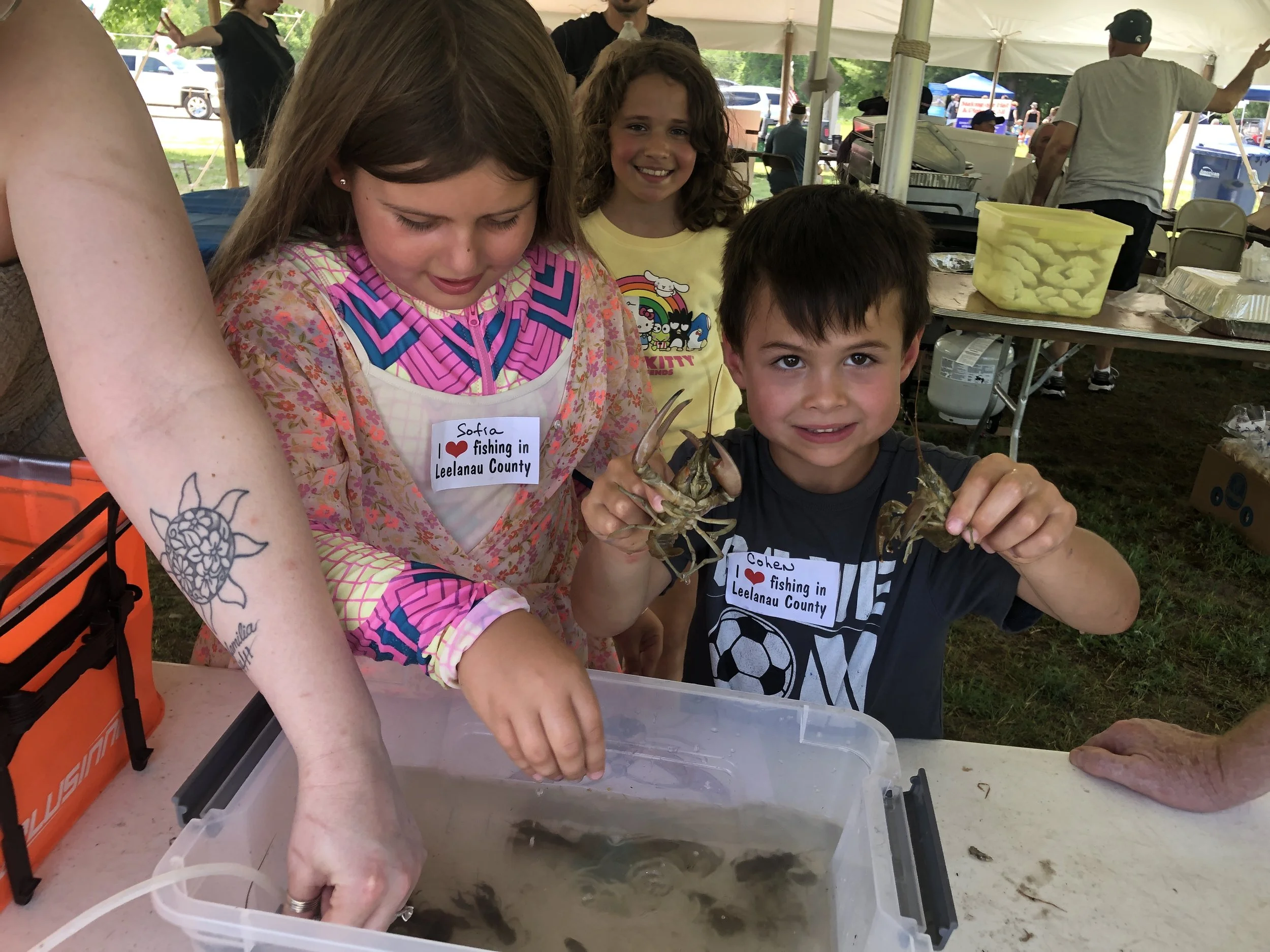
Kids seem to have as much fun with an amphibian display organized by Jim Kacin and friends as they do munching on hot dogs and catching bluegills at Kids Fishing Day.
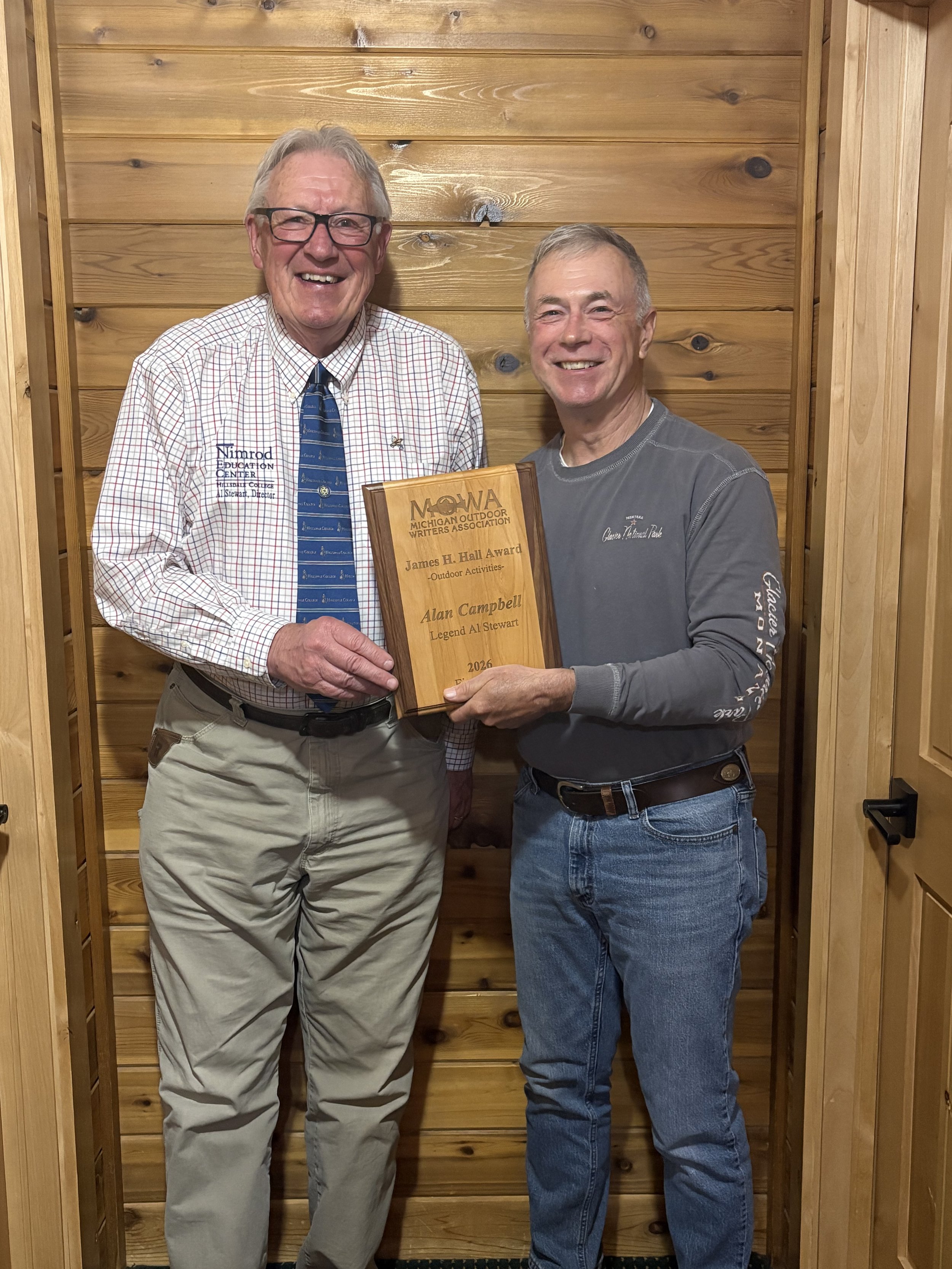
I was honored to receive a first place award from the Michigan Outdoor Writers Association for stories I wrote about Al Stewart (pictured), retired Michigan wild game bird specialist and now director of the Nimrod Education Center at Hillsdale College.
On some personal notes …
June 1st, 2026
Usually I stick to only county commissioner topics in this newsletter, but with your patience I would like to include three other personal items. They are:
• Kids Fishing Day is set for Sunday, June 28, at Veronica Valley County Park. There’s a small crew of us who have been in preparation mode for the big event. Soon we’ll be putting out flyers, advertising, and preparing the Kids Fishing Pond for the big event.
If you would like to volunteer, please give me a call at 231-492-4972. We’re always in need of volunteers, from helping to line up parking to walking the shores of Kids Fishing Pond, helping youngsters untangle lines and release fish.
This year my wife, Debra, is really helping out with fundraising and organizing before, during, and in the aftermath. I’d be lost without her (and sometimes she says I’m lost anyway!). My son Cody helps with setup and runs a learning station for youngsters who want to learn to clean their catch.
Please consider attending between 11 a.m. and 3 p.m. After planting 3,500 bluegills in the pond, we’ll be grilling hot dogs, providing arts and crafts opportunities, and in general offering a day for families to gather and enjoy a beautiful place.
• I consider it a high honor to have been asked to speak and lead an estimated audience of about 300 people in reciting the National Anthem at the county Memorial Day observance. I delved into the auspicious roots of the pledge, the brilliance of using the flag for symbolism, and why the anthem has buy-in with county residents. I took special pride in having my wife, Debra, and son Cody attend. Cody offered rides on our Gator, which was decked out in red, white, and blue, from parking lots to Veterans Plaza in front of the county government center.
• It was also an honor to have been awarded first place among the state’s outdoor writers for a story I wrote for Michigan Out-of-Doors magazine. The story encapsulated the amazing life of Al Stewart, a lifelong MDNR wildlife biologist who for years held the title of Upland Wild Game Specialist. In retirement, he leads the Nimrod Education Center at Hillsdale College, which fields one of the finest shooting sports teams in the nation.
