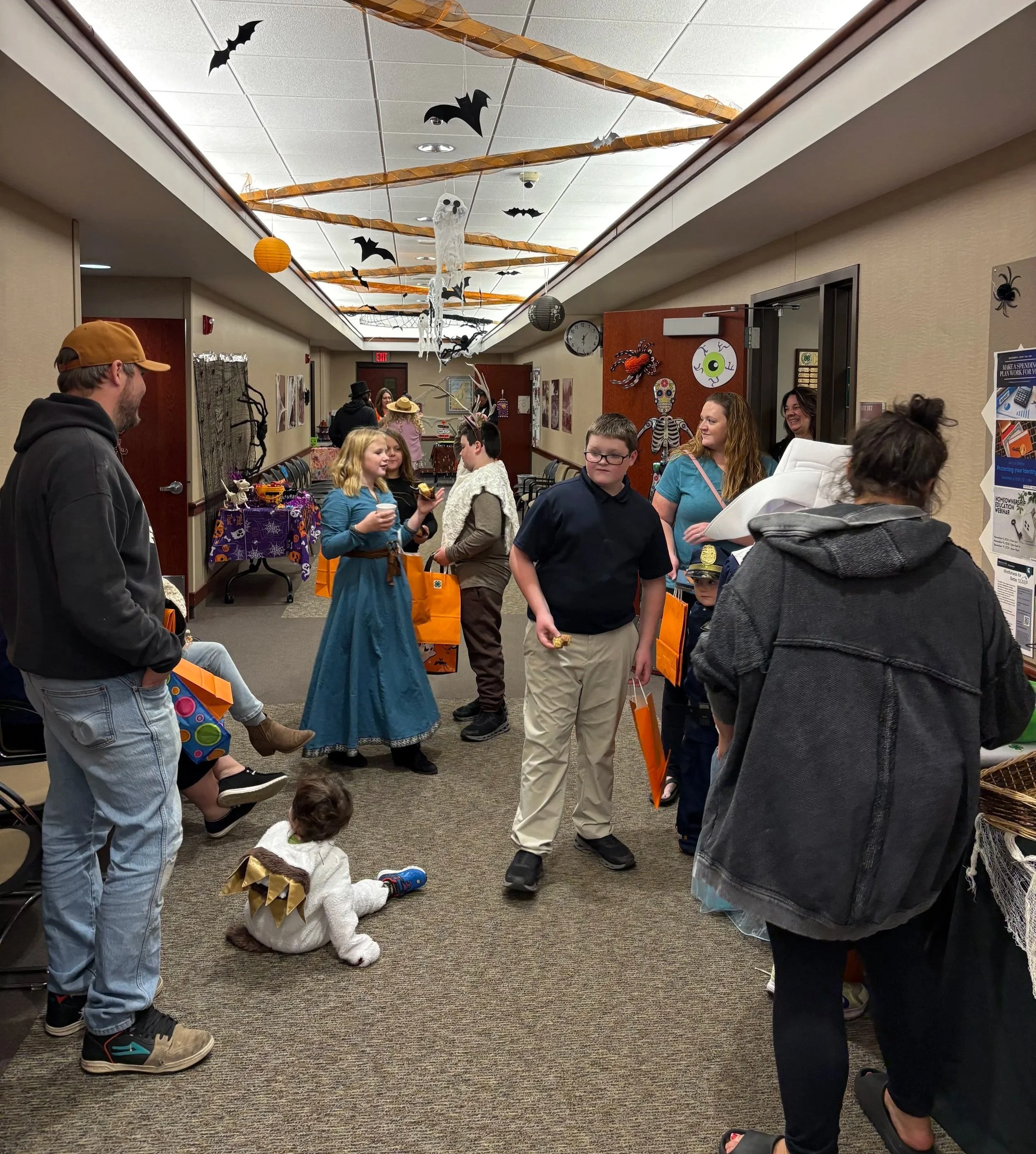
Young folks enjoyed a trick-or-treat party hosted by county staff in the government building. You may read about the event — and how a commissioner came to change his mind on school
Halloween parties — in Story 4 of this newsletter.
November: A Time to Plan with Budgets, Insurance Meetings
A newsletter provided monthly by:
Alan Campbell
Leelanau County Commissioner
Sorry for the boring headline, but it does seem that as a Leelanau commissioner, I’ve been hip-deep in all things financial for county government. What happened to those walks with sunny skies and falling leaves we were planning?
I’ve had some fun, I feel obligated to admit, bird and buck hunting ... But it does seem that this beautiful fall got away from us. The weather had been idyllic until it wasn’t.
The November newsletter, which you should receive just prior to the Nov. 10 board meeting, probably contains more than you want to know about county finances. They’ve been driven by rising health insurance costs, which we’ll discuss in detail.
Thankfully, there have been no notable resignations or firings, both of which have occupied too much of the county’s time for 10 months. Time to make progress.
I want to thank you for reading, and I’d like to encourage you to pass along the information herein. My goal is simple: to share news and thoughts about Leelanau County government.
Please forward this newsletter to anyone with an interest in Leelanau. I enjoy and read all feedback (and usually answer). Or give me a call at 231-492-4972. Your input gives me the inspiration and guardrails that help me be a better commissioner.
These views are mine; I do not know if they are shared by other county commissioners. I did not contact them for story content.
All past commissioner updates, along with related reports, can be found at Leelanaucommissioner.com.
National Politics Have No Place in County Business
November 9th 2026
When leaving the county building last week, I received a slew of unsolicited, highly emotional comments on midterm election results.
Emotional probably falls short as a descriptor of what I heard in the parking lot. Controlled but compelling anger comes closer.
The individual, who identified as a former Republican, welcomed the rejection of all things Trumpian. But it was his wrath I’ll never forget. Stored up and ready for ignition.
Gosh, I thought. I wonder how a card-carrying Democrat feels.
This is from someone I respect. I’m not sure why the verbal release was directed at me. I might have just been in the wrong place at the wrong time.
I don’t write about this chance meeting to relate the level of animosity held against President Donald J. Trump by Democrats and even former Republicans. I know many Republicans who hold an equal level of resentment stemming from shock and disgust with election results. The president in whom they invested personal equity was repudiated. Many turned to faith for solace.
I do write to relate how the midterm results will change my work in representing District 5 constituents, including the 2,599 who voted in the 2024 General Election.
It won’t. And it shouldn’t.
One reason is that the impact of the federal government on Leelanau County is minimal, whether led by President Trump, President Biden, or whoever next commands Air Force One. That’s the beauty of a multi-level representative democracy. It’s communities that grasp the reins of their self-determination. Not that state and federal authority doesn’t have an impact, mostly through carrots (grants) and sticks (regulation).
When they overreach, local representatives often call them out, and judges often explain their lanes.
Our imperfect system works better than any other.
I’ve published a commissioner newsletter to inform residents of the goings-on in county government every month since taking office on Jan. 1, 2025. I’ve never talked about national politics in its pure form.
So this is a first.
Instead, I try to provide a view inside Leelanau County government, writing about its wins and losses, its successes and failures, its flaws and strengths.
Part of those newsletter reports deals with my role as a commissioner. It’s my nature to talk a lot in public meetings, ask a bevy of questions during meetings and before (mostly working with staff), and, after hearing rebuttals, drop misconceived notions faster than the sun sets over South Manitou.
But here’s the thing I’ve found as a county commissioner: Rarely do we deal with subjects that are political in nature.
Common are decisions that revolve around good governance and fiscal responsibility. I ran on both issues. They remain my highest priorities.
I don’t consider good governance and fiscal responsibility to be Republican or Democrat matters.
On a national level, both parties have failed taxpayers.
Which brings us back to the midterm election impact on how I will conduct myself as your commissioner.
My priorities haven’t changed because new politicians will hold speaker’s gavels in Congress.
Leelanau, not Washington, is what matters.
I hope not to write about politics again.
Tweaks to Budget Bring Expense, Revenue Closer
November 9th 2026
Ladies and gentlemen, we have a budget.
From this commissioner’s perspective, it’s been a long haul.
The Leelanau County Board of Commissioners on Tuesday is expected to recommend approval of the county’s 2027 proposed budget at its executive committee meeting. The recommendation would lead to a resolution on the County Board’s agenda for its regular meeting set for 6:30 p.m. Tuesday, Nov. 17.
A public hearing on the spending plan is scheduled to begin 15 minutes after the gavel falls at the regular meeting.
The updated budget, which should be posted on the county website by the time you receive this newsletter, was tweaked by interim finance director Fabian Knizacky and presented to commissioners at a budget hearing held last Wednesday, Nov. 4. We agreed with the recommendations and added one of our own to reduce by $40,000 the need to draw from fund balance to even up expenses and revenues.
The bulk of the budget was written by former finance director Rio Risbridger, who resigned without notice after unfounded allegations were directed at her by a county commissioner.
Health care costs are the major driver in Mr. Knizacky’s changes. Commissioners previously had opted to deal with a possible steep rise in costs after Feb. 1, 2027, when a contract expires with insurance broker BHS. Rather than plug in a higher figure than the $2.6 million contained in the 2026 budget, commissioners planned to hold off adjusting the projection until a more accurate estimate became available and changes for 2027 were discussed.
Three firms, including BHS, replied to a request for proposals and are seeking to administer health care to the county workforce.
Make no mistake, the health insurance recommendations by Mr. Knizacky create a sizable, yet manageable, gap between projected revenues and expenses.
Again, health care has become the major driver in the 2027 budget process. We’re dealing with big figures that in turn will have a major impact. I’ll discuss the three firms vying to provide the county’s health insurance policy in a separate writing.
For now, let’s delve into the storylines behind the proposed budget:
• The 2027 proposed expenditures have been increased to $19.34 million. That represents 4.5 percent more than the 2026 amended budget of $18.51 million. A budget deficit of $702,342 is projected. The majority of the deficit, $575,000, is directly related to a jump in the health insurance category recommended by Mr. Knizacky. Being self-insured and in the midst of selecting an insurance broker, we have no way of knowing today where the line item will finish on Dec. 31, 2027.
Budgeting, I’m learning, is an inexact science best conducted with caution. We’re erring on the “rather be safe than sorry” side of the equation.
• A secondary and less obvious reason for budget increases has to do with higher wages as provided in three-year union contracts and a decision to change from 35- to 40-hour workweeks. Both were approved by the previous County Board. We, as commissioners, agreed to provide higher wages to elected officials (excluding commissioners) and their deputies in 2027 to ensure at least a 10 percent gap between them and unionized personnel they supervise. That decision will cost about $24,000 in the 2027 budget.
• The health cost change and others recommended by Mr. Knizacky create a gap between revenue and expenses of $742,342. He also suggested cuts to reduce the deficit. Through the years, it has been commonplace for the county to backfill deficits in budgets with “fund balance” carried over from previous years. However, the same fiscal year usually ends up in the black without dipping into banked surplus. For instance, approved budgets in 2023 and 2024 relied on “fund balances forward” of $1.5 million and $990,000 to make ends meet. Audits after the fiscal year was complete provided better results, with 2023 ending up $89,000 in the black and ’24 finishing even better, with revenues outpacing expenditures by $282,000. The 2025 audit determined a $470,000 surplus.
• That said, heading into 2027 with a deficit on paper of nearly three-quarters of a million dollars presents an ugly scenario. Through several cost-saving measures and some window dressing, we kept the difference as low as possible. In the window dressing category, we lowered the contingency fund from $400,000 to $100,000 and changed the revenue source to supplement our retirement plan. Now we’ll make an additional $275,000 contribution to the Municipal Employee Retirement Fund through $275,000 withdrawn from the county Delinquent Tax Revolving Fund. Also, property tax revenue, the main revenue source for the county, was increased $99,000 to $14.34 million after consultation with the county treasurer.
I pressed to keep the contingency fund at $400,000, but found no support. My reasoning was that funds would remain available if needed whether budgeted as contingency or fund balance.
• Eliminated, or at least put off for now, was a $109,076 contribution toward a massive overhaul of our emergency responder communication system. Also removed was the $31,500 purchase of oblique imagery sought by the Equalization Department to provide detailed aerial photography.
• An increased contribution to the Northern Lakes Community Mental Health Authority, which serves five counties, including Leelanau, was deleted. Our County Board was the first to embrace a request for more local funding, but other counties were reluctant to commit.
• Some $40,000 was originally budgeted to supplement the work of the Leelanau County Brownfield Authority, which commissioners were led to believe was devoid of funds. However, at the budget meeting, new information emerged showing that the organization already had about that amount in funds held for Brownfield use by the county. Given that no Brownfield projects so far have been requested in 2027, the funds were removed from the budget to reduce the deficit.
Dealing with Rising Health Care Costs Becomes Priority
November 9th 2026
Health care is a pain in the butt that no chiropractor can fix.
That’s my feeling on the subject. I’m sticking to it regardless of the optimism brought by representatives from three firms that hope to provide coverage in 2027 to the county workforce.
All of them, including our current provider BHS, understand that Leelanau County cannot continue down its current path that includes paying twice as much for family care as the cap recommended in state law for health care expenses paid by local governments.
I love this quote from Robert Hughes, president of Advantage Benefits Group, when discussing his firm’s chart comparing cost with the quality of health care provided by ten northern Michigan hospitals: “There is actually more evidence that lower cost equals higher quality.”
Representatives from Advantage, OVD (shout-out to Logan Suttman of Leland, who led his firm’s presentation), and BHS, our present health insurance provider, made their pitches during a nearly 3 1/2-hour special session last Wednesday, Nov. 4.
It was refreshing to hear optimism on a topic that has given commissioners past and present headaches because of rising costs.
But it’s more than just controlling increases or lowering costs. Many of our employees chose to work for county government because they know our Cadillac plan will take care of their needs.
The last thing we need in the county workforce is brain drain because we pulled the plug on benefits. Finding that fine line delineating overburdening taxpayers while ensuring employees are comfortably taken care of must be our focus.
Here’s some history. Leelanau County addressed rising costs in 2012 by making a dramatic change: becoming self-insured. The county picked up health care bills, including pharmaceuticals, up to a stop-gap level of $20,000 per enrollee. Blue Cross Blue Shield took over payments above the $20,000 level.
That worked well for several years— the county was actually beating cost trends — until 2025 when county coffers forked over $2.46 million. The figure represented a nearly 18 percent jump in just one year.
The county upped its stop-gap level to $50,000 in 2026 to avoid much higher premium costs, but in retrospect, finding a level someplace in between would have saved money. We were warned that the county’s tally for '27 could come in at $3.1 million, but it now looks like $2.8 million to $2.9 million will be closer.
Still, the 2026 budget only anticipated a $2.6 million health care bill. We’ll be cutting into our fund balance to make up the difference.
Not good, but manageable with a General Fund fund balance that today sits between $7 million and $8 million. Our checkbook will be tight in August and early September, though, before property tax revenue starts to roll in. Taxes are due in mid-September.
Still, the amount paid by the county for health care is an almost ridiculous number. As an example, the cost to county government for an employee’s family coverage is about $44,000.
That’s nearly double the $22,310 “hard cap” amount for 2027 as written into state law for local governments, which can opt out of the ceiling. Leelanau County started opting out four years ago. The gap has grown since.
I learned during the meeting that health insurance companies collect commissions from BCBS on policies they administer, so much that neither OVD nor Advantage Benefits Group would charge the county for their services. BHS offered to cut its current bill of $33,000 in half.
As to how the county might lower costs, several options would be on the table, including setting up health care savings accounts for employees who don’t require much in health care to establishing free walk-in health clinics in partnership with other local governments. Using a provider other than Blue Cross for drug coverage should also be discussed.
As it now stands, Leelanau County spends nearly 16 percent of its General Fund on health care. We’re working on ways to lower that percentage.
During commissioner comment, Will Bunek said something that resonated with his colleagues: “I’m learning more than I’ve ever wanted to know about health care.”
We’ll be choosing an insurance company this month to help lead us through this budget quagmire.
On a Long Agenda, Halloween and the Right for Public Comment
November 9th 2026
Since space is unrestrained on an emailed newsletter, quite a departure from my “ink by the barrel” newspaper days, please allow me to push on to some new topics:
• Every third week in October, I have the pleasure of reconnecting with farm families I’ve gotten to know through the years near Webster, SD. While the excuse is pheasant hunting, I find myself following conversations more than my bird dog. Two favorite conversationalists are Cris and Bob Sichmeller, whose political careers are decidedly local.
He is one of three trustees on the Raritan Township Board; she is the treasurer. Each trustee rotates annually into the supervisor role, sharing the load. Asked why the Sichmellers continue to run and be re-elected, Bob replied in his matter-of-fact delivery, “Someone’s got to do it.”
I’ve forgotten how many people live in their farm-family-dominated township, but it seemed something like 100. Visitors at meetings are rare. Unless providing prior notice to be placed on the meeting agenda, folks in attendance are not allowed to address the board.
I found this fascinating given the leverage held by people attending public meetings in Michigan to stand and speak their minds. We’re fortunate to have such a strong Open Meetings Act. And in Leelanau County, we’re fortunate to have so many constituents unafraid to offer their opinions during public meetings.
Please consider attending County Board meetings on the second and third Tuesdays of each month. I believe I speak on behalf of all commissioners in extending an invitation to help us make better decisions.
• That said, we have a long yet relatively straightforward agenda set for the executive committee session, which is scheduled to begin at 9:30 a.m. Tuesday, Nov. 10. Among the more interesting topics are a change to the rules for Myles Kimmerly County Park and a change in the lease agreement with a nonprofit allowing the consumption and sale of alcohol for its events.
This topic has been discussed for longer than a year and has the support of the county Parks and Recreation Commission. The nonprofit is the Leelanau County Historic Preservation Society, which single-handedly has been responsible for the preservation and renovation of the “Poor Farm Barn” located on the north side of County Road 616 in Kasson Township. The organization held three concerts that were well attended in 2026 as fundraisers to further improve the barn and grounds it has leased. No alcohol was sold, but some likely was ingested. There were no beer police present.
I liken the society to the Fishtown Preservation Society, Leelanau Community Cultural Center, and the Bay Community Theater Organization in their infancies.
I feel we need to give them the tools needed to succeed. Yet we need restrictions to prevent a resurrection of Woodstock.
The topic is but a blip on a long agenda whose packet, which is available online to the public, totals 260 pages. I’ve got some reading ahead of me.
• An initial decision to cancel what has become a Halloween tradition for Leelanau County was reconsidered, much to the delight of 75 to 100 kids who trick-or-treated at the county building. At first, I was a skeptic about holding the event, but after attending and seeing the joy spread by youngsters in costume, I think it was a good choice.
Headwinds were apparent when Halloween occurred on Saturday, and early voting occupied the commissioners' meeting room. The county Halloween gathering was hosted late Friday afternoon.
Thanks go to Clerk Michelle Crocker and her staff for working through the masked visitor invasion, and to all county workers who introduced young people simultaneously to Leelanau government and the importance of voting. Many employees wore costumes.
While services remained available to the public, government center halls were decorated to provide a scary yet non-intimidating atmosphere.
I had a chance to chat with Commissioner Ty Wessell while dishing out candy. He related that at one stop in his career as a superintendent in school districts, he chose to cancel Halloween during school hours because of the time it took away from studying. That was apparently an unpopular choice. The next school board meeting was full to the aisles.
“Did you end up having Halloween?” I asked.
“Of course,” he replied.
