Leelanau Commissioner Update April 2026
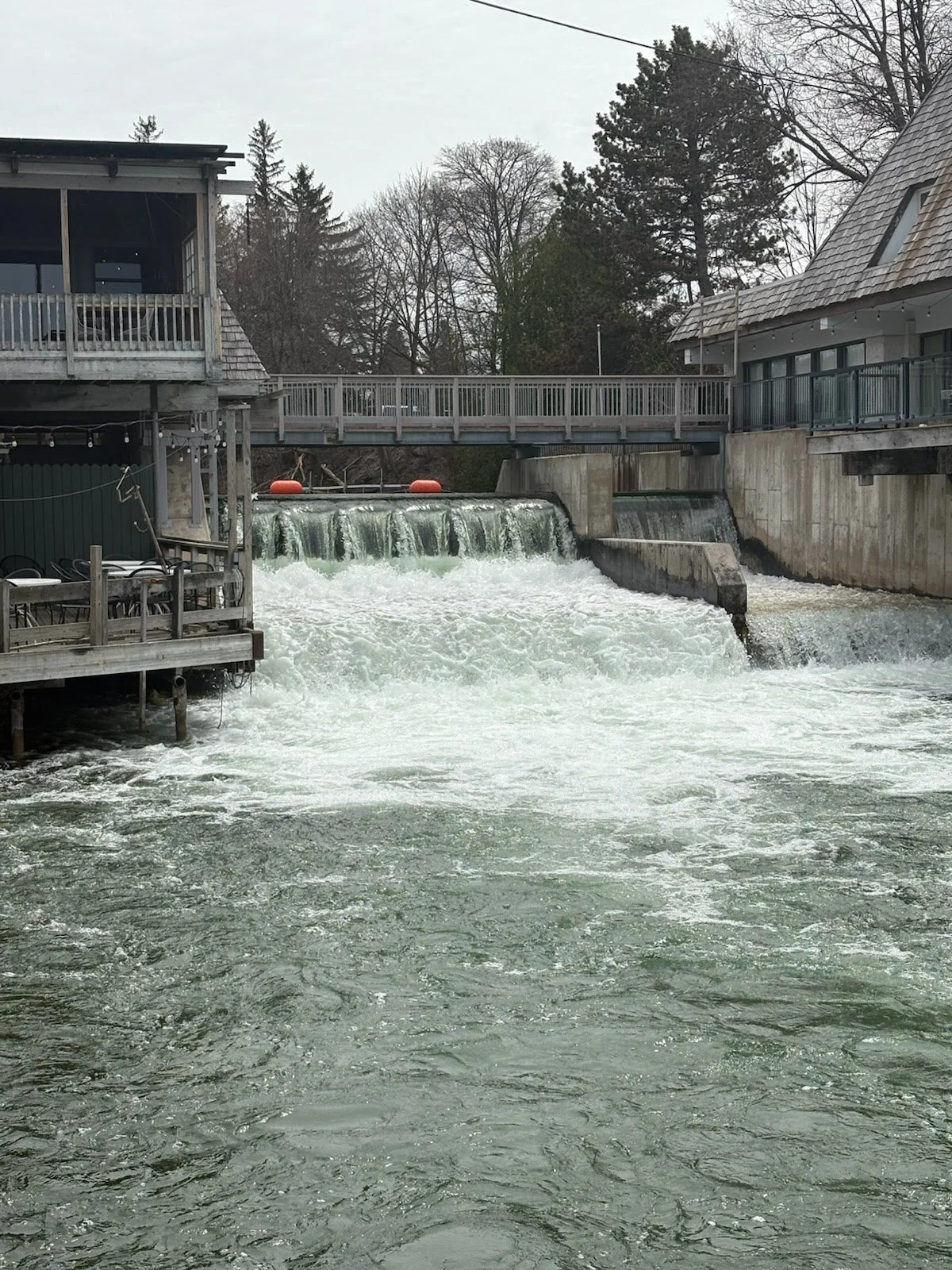
High water has been the lead story for much of Leelanau County, including on Lake Leelanau. Inside this commissioner newsletter you’ll find an update on conditions at the Leland Dam, which is structurally sound but in need of repairs.
Provided by Alan Campbell Leelanau County Commissioner District No. 5 (Leland and Centerville Townships)
Enough of showers, Let’s have May flowers.
Dear Readers:
Spring’s here, albeit buried underwater.
It’s a pleasure to introduce the April edition of the Commissioner Newsletter, which follows a newsworthy month for the Leelanau County Board of Commissioners.
And for the weather. Some 7.45 inches of rain was recorded in April as of the end of last week, compared to a historic average of 2.45 inches for the time period. You’ll find some good news in this report, as the Leland Dam remains sturdy despite the heavy flow of water raising the level of the Leland River.
Perhaps it’s raining while you’re reading the newsletter. Regardless of whether you’re hunkered inside or enjoying the trilliums that will blanket forest floors this month, I appreciate you reading the newsletter and staying in tune with happenings within county government.
I write and distribute the newsletter to keep folks informed. I welcome your feedback. Please provide your thoughts and comments through the link below.
Also, please consider forwarding this email to others with more than a passing interest in Leelanau County. A sign-up link is provided. It’s also easy to stop receiving the newsletter through another link.
Past emails and reports can be found on my website, leelanaucommissioner.com.
Author’s Note: Content is provided by Alan Campbell
An Invitation To Clerk Reception
April 27th, 2026
Who would have thought that a resolution recognizing Michelle Crocker for being the longest-serving county clerk now in office in all of Michigan would create such an uproar at our most recent executive board meeting?
Certainly not me. I thought the resolution was a no-brainer, as its timing was designed to correlate with an anniversary celebration set for Thursday, April 30, in the Community Meeting Room in the county government center. Doors will open at 5 p.m.
It was on May 1, 1996, that Circuit Court judges Thomas Power and Philip Rogers appointed Mrs. Crocker as county clerk following the retirement of Dorothy Wunderlich. Mrs. Crocker, who was working in the clerk’s office before the appointment, went on to win eight successive elections.
She has been clerk for 30 years and has worked for the county for 45 years. The first is tops in Michigan; the second is tops within county government.
Clerk Wunderlich served 18 years, meaning that only two people have held the office for nearly half a century. That’s stability.
I have no intention of countering the reasons given by four commissioners who voted against the resolution I brought to the meeting with the expectation that it would receive unanimous support.
What I’d like to do instead is invite everyone to the celebration. It promises to be a hoot. Folks sharing a microphone will include Circuit Court Judge and former state legislator Kevin Elsenheimer, as well as Bonnie Toskey, a principal with Cohl, Stoker, Toskey & McGlinchley.
The law firm has represented Leelanau for as long as I’ve known the county. Bonnie will bring some war stories not sealed under attorney-client privilege.
Enlightening participants will include Chet Janik, the mayor-in-waiting (behind Ray Pleva) for Cedar, which is described by Mr. Janik as the cultural capital of Leelanau County. He served for 11 years as Leelanau County administrator, bless his heart, following a distinguished career in education. He served as superintendent at Charlevoix and Buckley school districts after a long administrative stint at Northwestern Michigan College.
County Board Chair Yoder will also speak. Actually, make that former chair Pat Yoder. Mr. Yoder served as the first St. Joseph County administrator in 1990, returned to his native Leelanau County where he was elected commissioner and board chair, was hired as administrator in Wexford County, then finished his career with seven years back as St. Joseph County administrator.
The dude knows county government.
I knew close to nothing about counties when Deb and I moved to Leelanau in 1997 after purchasing the Leelanau Enterprise. I didn’t understand the intricacies of a government structure with an elected board of commissioners separate from independent, elected offices such as sheriff, clerk, treasurer, and register of deeds. I also didn’t know the players, many of whom were lifelong residents with deep family ties. Regrettably, I struggled with editorials.
But I did find a reliable source for information in Michelle.
Need a copy of the budget? Take this one. Looking for a contract with a business? We’ll get you a copy. The clock is striking 5 o’clock, so maybe we can talk tomorrow? Don’t worry, Michelle would answer—we usually work after hours anyway.
It’s unfortunate but understandable that she is known to some as a controversial figure. During the many years that her office oversaw county finances, it was her job to report possible monetary oversights and budget overages. She was the “no” person in county government. Some relationships strained.
But no one can question her work ethic for the county.
So please consider joining in the celebration to recognize the longest-serving county clerk in Michigan. It’s a historic moment that should be shared.
Grant Discussion Helps Explain Friction in County
April 27th, 2026
After well over a year into my role of helping to steer county government, I see recurring friction in one area that, frankly, probably isn’t going to change.
That is where to place the line of demarcation separating the roles of commissioners and the county administrator.
This isn’t an alarm bell. Staying civil, which in general all parties have, is the key to buffing out rough edges in local government. Disagreement in the form of open and public debate creates healthy results for a representative democracy.
Disagreement when it becomes personal has the opposite effect. That hasn’t happened.
Commissioners had a respectful discussion at our April 14 meeting about grants, of all things, that might help explain.
Grants are a big thing in county government — and most local governments, for that matter, as well as nonprofits. Within Leelanau County government, grants are usually uncontroversial, almost always require a match with county funds, and can stretch taxpayer revenue to accomplish more.
They require oversight and maintenance to unleash their worth. That’s required under the current policy, which places much of the responsibility for grant oversight with the county finance director.
County Board Chair Steve Yoder placed “grant policy revisions,” from inception through completion, as a discussion point on our agenda. He was working closely with County Administrator James Dyer, who had rewritten what he thought was our current policy.
What confused the issue was that Mr. Dyer was working from an outdated grant policy from 2012. The current policy was revised in 2024, making it less than two years old.
Some changes I agreed with. Some I didn’t.
Oversight responsibility of grants would be switched from the finance director to the administrator. Also, the new version would authorize county officials — defined as elected officials and appointed department heads — to submit a notice of intent to apply for a grant to an “authorizing official,” which was listed as the county administrator or County Board chair. In the 2012 policy, which was presented to commissioners in the changed format, the county clerk was also listed as an authorizing official.
The change that caught my eye would switch final authority to apply for a grant from the County Board to the administrator or County Board chair.
Under the current policy, a vote of the Board of Commissioners is required for the county to apply for a grant.
The proposed policy calls for a vote of the board only after a grant had been applied for and approved — basically, after the fact.
The point I made was that placing commissioners’ role at the end of the process was not fair to grant providers should we decide to turn down a grant. The timing would be a step toward de facto approval of all grants for programs favored by the administrator, who does not hold an elected office.
The role of commissioners was further reduced — actually eliminated in certain cases — by a clause that left us with no choice but to accept certain grants. It stated, in part: “The Leelanau County Board of Commissioners shall approve all grant applications that (1) fund the wages or benefits of a new or existing employee ...” Grants that funded unbudgeted projects and “in the opinion of the County Administrator create a structural change in the budget ...” would also have to be approved by the board under wording in the proposed grant policy.
The new hire-funding premise goes against my governing instinct. Instead, I prefer to avoid using time-limited funds to expand staff.
I expressed other concerns:
• Nowhere in the proposed policy was the administration required to inform the board of grant submissions.
• Commissioners had, within the past few months, approved a policy governing the Grand Traverse Band grant application process that directly contrasted provisions in the proposed policy before us.
We held an enlightened discussion at our executive committee meeting. Perhaps recognizing the confusion of having three documents in the mix — the 2012 and 2024 policies, plus changes to the 2012 policy — commissioners opted to remove “grant policy revisions” from the agenda at our April 21 meeting. A week earlier, I joined Commissioner Will Bunek in voting against advancing the proposed policy.
My thought was that we needed to start anew using the current policy as a base with the inclusion of thoughts offered by commissioners. And then we need time to digest whatever policy evolved from the administrator before voting.
Actually, after reviewing the 2024 policy, I don’t see a need for more than a tweak or two, if that.
With all that said, I also recognize that under certain conditions County Board approval could be eliminated for some grant submissions. I’m talking about smaller requests that are blended into our budget and help fund ongoing activities. But frankly, I don’t see County Board approval as a block to the grant application process.
As part of commissioners’ oversight responsibility, I continue to believe most grant requests should be given County Board approval. The long-established process of requiring the board’s blessing keeps commissioners informed about the government we are charged with overseeing.
Continuing the tradition also offers opportunities for constituents to learn about and comment upon the inner workings of the government they pay for.
A simplified summation of our grant policy discussion would be to dismiss the issue as a power grab attempt by Mr. Dyer, or an effort by commissioners to micromanage the administrator.
Instead, I would characterize it as a process to define our places in improving the function of county government.
Being that the participants are strong-willed individuals, we’re likely to incur some friction along the way.
Slow but steady on county ethics policy
April 27th 2026
No, I haven’t forgotten that Leelanau County needs an ethics policy.
Although I wouldn’t blame residents for assuming I have.
It’s been nearing a year since I started speaking aloud about the need for a policy overseeing the actions of all elected officials, appointed officials, and even employees. Presently, the only similar documents are a “conflict of interest” policy that applies only to commissioners and their appointees to committees, and a “non-union employee” policy that requires the obvious—don’t drink on the job, don’t accept gifts that might influence your decisions, and, by the way, no stealing.
Actually, the latter policy is a good document for workplace standards, in my estimation. But neither policy goes into the detail of ethics policies adopted by Grand Traverse County and the City of Traverse City. This is a case where more is better—up to a point. I’ll explain that later.
The County Board established a committee to draft an ethics ordinance in December, and we met in the closing days of 2025. I was joined by Commissioners Steve Yoder and Gwenne Allgaier. We had a respectful discussion.
Not much happened—as in, to my knowledge, nothing—for the next three months, which were filled with a lot of other county business on the plates of commissioners. Anxious more than frustrated, I went to the drawing board, using the Grand Traverse policy as a base to write ethics guidelines that I feel are appropriate for Leelanau.
It’s a complicated area because of the different classes of county employees and officials involved. A policy passed by commissioners can affect commissioners, but it has no teeth to dismiss someone even after severe misconduct. Ditto for other elected officials such as the clerk, treasurer, and sheriff.
Unionized employees are governed by standards in their contracts with the county. They could use an ethics policy as a guideline—and, to my knowledge, are already following its mandates—but would not be bound to abide by the policy or accept its penalties.
Still, the issue is worth pursuing. The present conflict of interest policy discusses only financial aspects of ethical behavior. It would be good to expand the definition.
Back to the issue of “more is better” in an ethics policy. Many similar policies call for the creation of an “ethics panel” comprised of people not officially connected with local government to investigate complaints and determine their outcomes. I was concerned that the makeup of such a panel could become political, so I did not write one into the policy. Instead, I placed final outcomes under the jurisdiction of the County Board.
Do you agree?
Would you go a step further and take a look at the proposed ethics policy, which is posted at LeelanauCommissioner.com?
Your input would be appreciated. Commissioners have a ways to go before approving a new policy, should they decide to adopt one at all.
Please email me or simply give me a call at 231-492-4972 with opinions and suggestions. I welcome the conversation.
Q & A for your county commissioner
April 27th 2026
I’m always wondering what constituents want to know about their county government, which is why I appreciate fielding questions when we meet. While I don’t know exactly what you might ask should we meet today, I took the liberty of writing down some queries that might be on your mind. Such as:
1. Why didn’t the County Board step in when residents in drainage districts complained about cost and communication?
The simple answer is that we had no authority. Michigan law gives drain commissioners unfettered power over the administration of drainage districts once they are established. For the record, I respect and enjoyed my conversations with former drain commissioner Tim O’Non, who resigned effective March 27 to spend more time with his family’s business.
That said, appointed drain commissioner Chet Janik is off and running. He reached out and is meeting in groups and individually with residents of drainage districts. He’s taking their concerns seriously. One major step in bridging differences was his decision to waive fees for public documents sought by residents. The Freedom of Information Act fee for one request alone was $340. As an elected official, Mr. Janik has the authority to waive the fee.
Mr. Janik is in his office all day on Mondays and is quick to respond to phone calls, emails, and texts.
He will continue as drain commissioner through Dec. 31, after which the winner in the general election will assume the position. Only former county commissioner Melinda Lautner has filed for the primary. She will appear on the ballot as a Republican. So far, no residents have filed to run as independents.
2. I’ve heard there are cracks in the Leland Dam. Is there a danger of it failing?
Going again with the simple answer: No. But expensive maintenance is needed. The Spicer Report, which provided an overview of the health of the dam along with estimates for its essential upkeep over the next four years, put the chances of failure at one in ten to the minus fourth degree. I’m no mathematician, but that seems like very low odds.
But the dam needs attention. The left concrete abutment is “spalling”—a term for superficial deterioration—and a one-half-inch crack was recently noted on the upstream face of the first pier.
The total estimated cost for monitoring, engineering, and reconstruction comes to somewhere between $500,000 and an appalling $1.5 million. However, state grants are available to cover 75–90 percent of the cost, which takes the price tag down to a more palatable $50,000 to $300,000, the report estimates.
The County Board, at its April 21 meeting, authorized the administration to apply for all grants mentioned in the Spicer Report. The first grant request will likely be for sensors needed to determine whether the crack is growing or stable.
3. I read about motions passed by commissioners supporting projects in Peshawbestown. Is county government and the Grand Traverse Band drawing closer?
I hope so. This story starts with Ty Wessell following through on a request by GTB attorney John Petoskey to pass a motion supporting the Tribe’s effort to secure a $1 million federal grant to build sidewalks in Peshawbestown, which is bisected by M-22. Efforts to have MDOT reduce the speed limit from 55 to 35 mph have fallen on deaf ears because the Tribe is not authorized in state statute to petition for the change. It’s not considered a municipality of state government like a township, village, or city.
But it’s a viable community nonetheless and deserves traffic safety.
Talking with Tribal Councilor Brian Napont on a different topic, I inquired as to whether a County Board resolution might help. Already pressing for the change were state legislators and state Attorney General Dana Nessel. I’m happy to report that both the letter of support brought by Commissioner Wessell and the resolution were approved by the County Board. I was fortunate to have an opportunity to present the resolution to the Tribal Council at their April 15 meeting, at which time we held a wide-ranging discussion about future opportunities for the county and Tribe to work more closely together. Thank you, Mr. Napont, for arranging that discussion following a last-minute text.
4. How are county finances going considering high turnover in the finance department, including within the past few weeks another account clerk resigned?
The truth is that I’m not sure. I had relied on a report providing a historic overview of monthly balances in county accounts from our previous finance director for a sense of where we were.
Administrator Dyer was very cooperative when I inquired. He said updated copies of the report will soon be available.
I can say the county equalization report provided by Andrew Giguere offered a positive sign for revenue. The taxable value, which has a semi-direct effect on property tax collection, increased 5.9 percent. That jump is likely not reflective of your property tax bill, as the individual taxable value increases allowed through the state constitution are capped at the rate of inflation. That rate was set at 2.1 percent in 2025. Exceptions were carved out for properties that were sold or improved. New construction also adds to the overall taxable value of the county. The bottom line is that property values in Leelanau County continue to be high and growing, with no end in sight.
Part of the revenue increase brought by higher taxable values will be offset by a reduction in the county millage rate required by the Headlee Amendment to the constitution.
We’re working under a tight budget, in my estimation, with a contingency fund reduced to $200,000. So please, dear Lord, no emergencies.
5. How can I get involved in what appears to be an upswing in interest in county parks?
One way is to purchase one of the six memorial benches that remain for Veronica Valley County Park. Three are already sold. The benches are part of a pilot program that, if successful, may be used at Myles Kimmerly and Old Settlers Park to fund future improvements. I feel Veronica Valley also badly needs a pavilion. The Park Commission has been authorized to apply for a 2% Tribal Grant to help fund its construction, and we’ll be looking for other funding alternatives.
Projects are also underway or in the planning stages at Kimmerly and Old Settlers parks. Please contact County Administrative Assistant Lauren Cypher, who will put you in touch with one of the chairs of park subcommittees that are leading park improvements.
